Civism
The Caves of SteelCivism is the civilization organized around Earth’s immense, integrated Cities, an answer to population pressure that turns efficiency into the governing principle of daily life. It makes large populations supportable through shared services and tightly coordinated infrastructure, but its steel-enclosed comfort is also a source of dependence: the same order that sustains City dwellers can leave them vulnerable to disruption, anxious about losing their civic privileges, and unable to imagine life beyond the City.
Origins and Urban Transformation
Before the Cities, Earth consisted of thousands of separate settlements open to the air. Even the largest held fewer than ten million people, and most remained below one million. As the population climbed from billions toward eight billion, progressively lowering living standards could no longer prevent semistarvation. The Outer Worlds, formerly Earth’s colonies, imposed severe immigration restrictions, intensifying the pressure to reorganize life on Earth rather than relieve it through emigration.
The transformation unfolded gradually over a thousand years. Civism followed a principle already visible in the shift from home industry to factories and then to continental-scale industry: efficiency depended on scale. Instead of duplicating a hundred thousand family kitchens and bathrooms, a Section could serve its residents through communal diners and shower rooms. A centralized film collection replaced innumerable private collections; video-piping systems replaced independent household video. Villages, towns, and the old, open cities were absorbed into the great Cities. The trend slowed during the prospect of atomic war, then accelerated after the invention of the force shield.
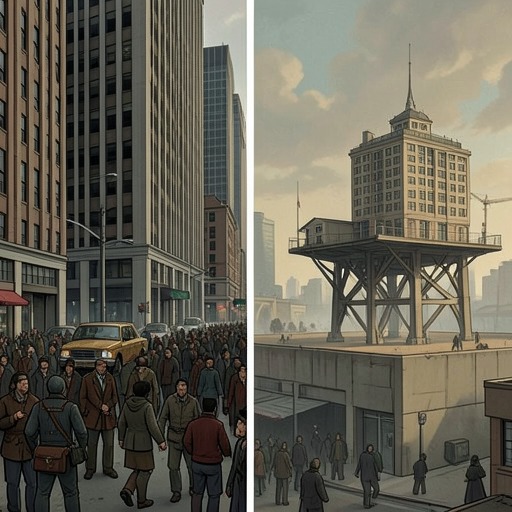
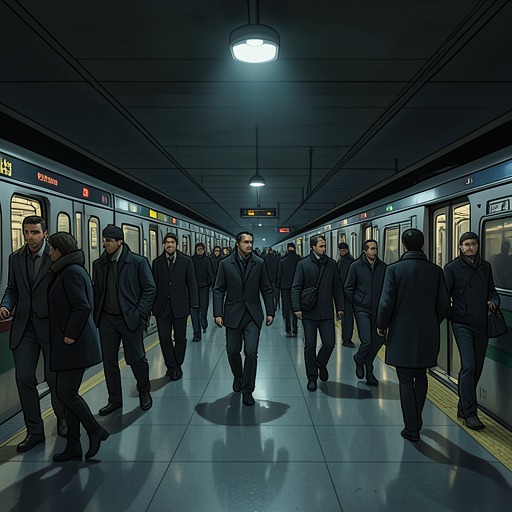
The scale of the resulting order is visible in New York City. It spreads over more than two thousand square miles and holds well over twenty million people; Earth has about eight hundred Cities, averaging ten million inhabitants each. Each City is nearly self-sufficient economically and can roof itself in, gird itself about, and burrow beneath the surface. The City is thus not simply a large settlement but a deliberately bounded environment, engineered to house and provision a mass population.
The City as an Integrated System
A City’s organization concentrates administration at its center and arranges large residential Sections in relation to one another and to the whole. Expressways and localways connect them. Factories, hydroponic plants, yeast-culture vats, and power plants occupy the outskirts, while water and sewage networks, schools, prisons, shops, power lines, and communication beams extend throughout the built environment. The phrase “steel cave” captures both the enclosure and the extraordinary coordination that make this structure possible: a cave of steel and concrete designed to master its surroundings.
That achievement rests on continuous flows of resources. Food distribution depends increasingly on yeast and hydroponics. New York must bring in water and carry waste away, keep nuclear plants supplied with uranium, obtain wood pulp for yeast vats and minerals for hydroponic plants, and circulate air without pause. The balance among these systems is delicate and grows more so each year. A City that once could have endured for a day on its own now could not withstand an interruption of its immense input and output for even an hour. Its efficiency is inseparable from interdependence: the larger the system becomes, the more quickly local survival depends on distant supplies and uninterrupted operation.
The narrative calls the City the culmination of humanity’s mastery over the environment—not space travel or the fifty colonized worlds, whose independence is described as haughty, but the City itself. Yet that triumph contains a structural vulnerability. A flood or crop failure once threatened a local population center; later societies could draw help from other centers, but at the cost of making broader regions interdependent. In the modern City, the dependencies are so extensive that a short break in essential flows could threaten the whole. Civism’s achievement and its fragility arise from the same design.
Status and Everyday Security
Civism is also a hierarchy of civic ratings, expressed not only in formal standing but in small, recurring advantages. A higher rating can mean a seat on the expressway during rush hour rather than only between ten and four, a better place on the Section kitchens’ list of choice, a chance at a better apartment, or a quota ticket for the Solarium levels. These privileges are modest individually, but their accumulation makes status tangible in the ordinary routines of City life.
The Commissioner’s warning that robots might eventually perform the work of police officers makes that dependence immediate for Elijah Baley. He describes replacement as a process already underway for twenty-five years, since the Spacers arrived, and fears that a failed investigation could bring the point nearer when police officers lose their jobs and pension security. Baley, a C-5, is offered responsibility for the case and the possibility of a C-6 rating. He recognizes what that advancement could mean for his commute, food choices, housing prospects, and Jessie’s access to the Solarium. The case is therefore bound to more than professional ambition: the promise of promotion and the threat of displacement are both measured in the privileges that Civism distributes.
The cost of losing status is made vivid through Baley’s family history. His father, once a nuclear physicist with a rating in the City’s top percentile, was declassified after being blamed for an accident at the power plant. Baley, too young to know the details, remembers the barracks and his father’s decline. His father died while still declassified; Baley and his two older sisters went to the Section orphanage, and his uncle could not prevent it. This memory gives the prospect of downward mobility a personal weight: for Baley, declassification is not an abstract administrative penalty but a condition that shaped his childhood and his family’s survival.
The City guarantees a bare possibility of existence even to those entirely declassified, but status determines the texture of that existence. An activated washbasin, a more comfortable seat, a better cut of meat, or a shorter wait can become part of the expected fabric of life. Losing an amenity once taken for granted makes each extra trip to a communal facility feel humiliating; a Sunday-night option on a real chicken drumstick can become something a person fights intensely to preserve. Civism’s privileges work through habit as much as display. Their power lies partly in how easily they become ordinary—and how painful their removal becomes.
Robots, Labor, and the City’s Limits
Robots expose a contradiction at the heart of Civism. Earth invented the positronic brain and first put robots to productive use, yet the Outer Worlds came to embody the culmination of the robot economy. On Earth, robots had long been restricted to mines and farmland; only during the last quarter century, under Spacer pressure, did they begin to enter the Cities. Their introduction threatens to displace workers inside a society where employment and civic rating are closely connected. R. Sammy runs errands, the Commissioner says, but other robots could patrol expressways or perform police work, pushing replacement upward into occupations that had seemed secure.
The shoe-store confrontation shows how an apparently minor application can carry wider social consequences. The shop’s Earthmade clerks are relatively inexpensive robots equipped to know shoe styles, prices, available sizes, and stock levels; they can calculate orders and measure customers’ feet. Each is limited and harmless in isolation, yet together they are dangerous because their useful work points toward human jobs being taken away. A protester connects robots to lost employment, families in barracks, and meals of raw yeast mush. Baley, facing the rising crowd with R. Daneel Olivaw beside him, recognizes more of the protester’s fear than he would have expected. The threat is not simply that machines can perform tasks; it is that their adoption may intensify the insecurity Civism already makes consequential.
For the Spacers, however, robot introduction is also a deliberate attempt to change Earth’s social balance. Dr. Han Fastolfe explains that displaced people could become the nucleus of a new colonization effort. In his account, those cast out by the City have little left to lose and whole worlds to gain; robots could accompany them and ease the first adjustments to life on an undeveloped planet. The proposal treats job displacement not as an end in itself but as pressure meant to loosen Earth’s dependence on its Cities and renew planetary migration. Yet Fastolfe admits that the plan is not working: Earthmen’s resentment of robots blocks the very cooperation that might make colonization practical.
Fastolfe’s criticism reaches beyond employment. He argues that people in the open settlements of the past were not so specialized that they could not leave and begin again on a raw world; Earthmen colonized more than thirty of the fifty Outer Worlds. City dwellers, by contrast, have become so sheltered within their steel environments that crossing the countryside to reach Spacetown can seem implausible, let alone crossing space to settle another world. For him, Civism is ruining Earth by making its inhabitants unable to break free of the system that sustains them. Baley resists the stranger’s judgment and insists that Earth’s future is Earth’s own problem, but the dispute identifies a central tension: Civism has made collective survival possible while narrowing the practical and imaginative paths beyond the City.
Historical Irony and Significance
Modern political writers praise civism as efficient and enlightened, contrasting it with the “fiscalism” attributed to the Medieval period. Their criticism of an economy based on money stresses brutal competition and the strain of continual struggle for the buck. Medievalists, by contrast, see fiscalism as a possible source of individualism and initiative. The novel does not settle the historical argument through Baley; he is reluctant to commit himself. Instead, his reflection on how deeply a City dweller may fight to retain even a small food privilege makes the contrast unstable. A society that has removed money as its organizing principle has not removed the struggle to keep what one has.
Civism’s central irony is that its success creates the conditions of its own constraint. Dense, coordinated Cities allow Earth to support enormous populations and to distribute food and services efficiently, but population continues to rise while the supply of calories requires ever greater effort. Cities become dependent on vast, delicate resource networks; their residents become attached to status-based comforts; and their specialization can make migration appear impossible. Robotization and colonization are proposed as ways to alter that balance, yet both encounter resistance rooted in the social order they seek to change. Civism is therefore neither merely an architectural form nor an uncomplicated emblem of progress: it is a material system that organizes survival, privilege, labor, and the limits of imagined freedom.